


Liminal Scape Inner Scope
December 10 – 13, 2026
Art Hall, Art Sonje Center
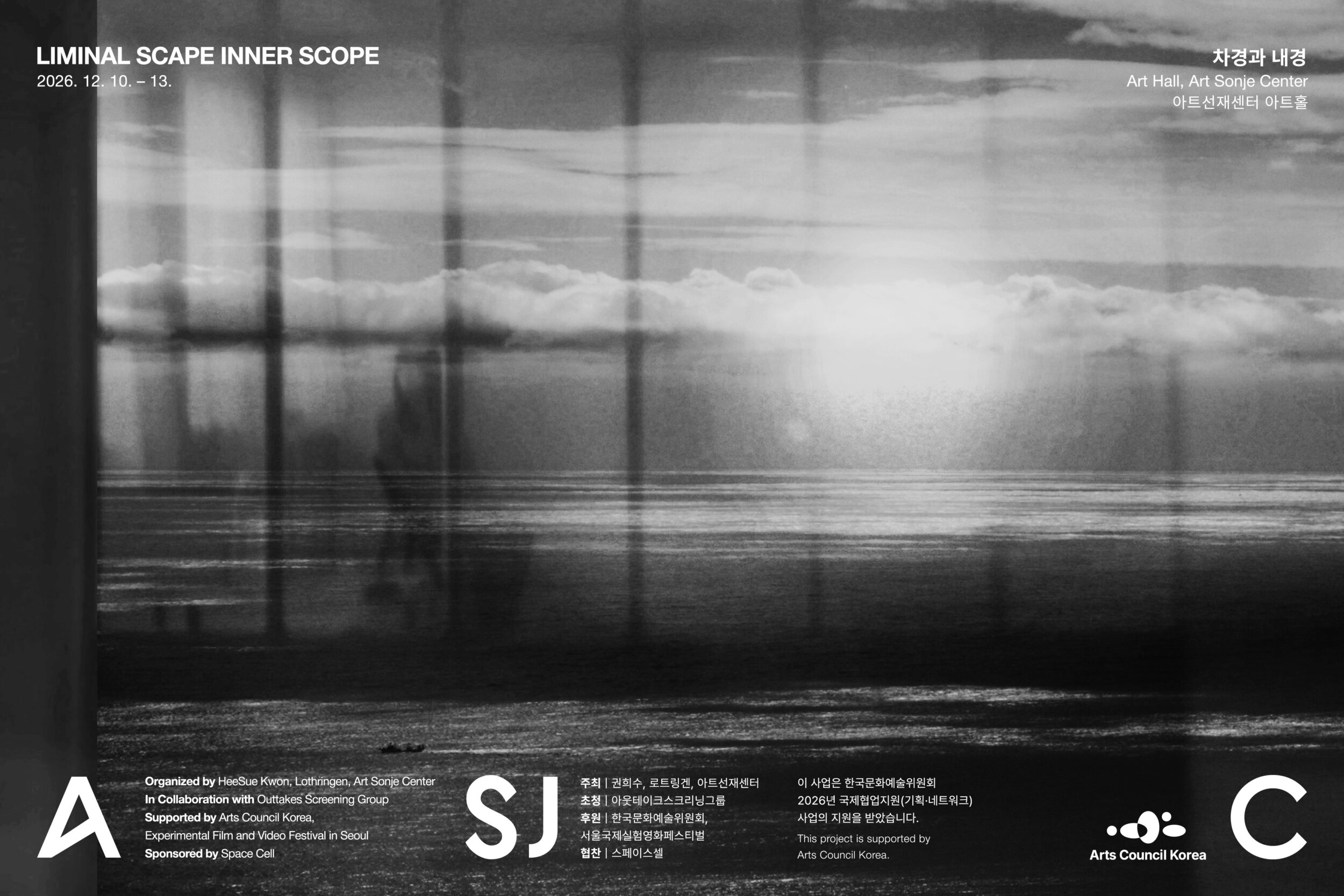
Liminal Scape Inner Scope
Art Sonje Center presents Liminal Scape Inner Scope from December 10 to 13, 2026. Co-organized by artist HeeSue Kwon, film collective Lothringen, and Art Sonje Center, the event introduces the curatorial practices of Lothringen, a Seoul-based film collective, and Outtakes Screening Group, an independent screening organization based in China. Taking place at Art Sonje Center’s Art Hall, This program comprises seven screenings including 16mm film screenings, and live performance programs, lectures, and one forum.
Liminal Scape Inner Scope brings together works that emerge from diverse questions concerning the act of seeing and the perception of images, alongside research into creative and screening practices situated at the intersection of film history and art history. Centering on the distinctive questions and sensibilities that artists have explored through their respective practices, the program highlights cinematic practices developed across different periods and regions, as well as the personal experiences embedded within them.
Lothringen is a film collective formed by filmmakers who organize film screenings, while Outtakes Screening Group is an independent screening collective based in China. Both groups have developed their respective screening programs encompassing experimental film, film performance, expanded cinema, and moving images. Drawing on her experience of participating in the programs of both groups as an audience member and an artist, HeeSue Kwon has brought together a space where their distinct curatorial approaches meet.
The event is particularly significant in that it invites Outtakes Screening Group and film programmer Pincent Liu to Korea, introducing contemporary Chinese experimental cinema and emerging independent screening cultures that remain relatively unfamiliar to local audiences. Through screenings and a lecture by a curator working in the region, the program explores diverse currents in Sinophone experimental cinema while opening up discussions on the conditions of filmmaking and screening in different regions, and on how independent screening networks are formed, sustained, and developed.
On December 10, the opening day, HeeSue Kwon presents Iris, a live screening performance. Conceived as a three-part work combining live camera, digital moving images, 16 mm film projection, and live sound, the performance unfolds in real time, revealing how images emerge and transform both on and beyond the screen. Later that day, the forum Experimental Film Practices in Korea and China Today, featuring Il-hwan, Wang Yujian, and Pincent Liu, brings together perspectives on screening cultures in the two countries and examines the conditions necessary for sustaining these activities and networks.
On December 11 and 12, screening programs curated by Lothringen and Outtakes Screening Group will take place. On December 11, Lothringen first presents Light-meter / Inward-scape, featuring works by Sarah Pucill, Maria Klonaris, and Manon de Boer, which explore questions of light, images, and visual perception. This is followed by Space as a Trace, curated by Outtakes Screening Group, which brings together works by Zhou Tao and Chen Jiayi. Through these works, the program examines landscapes of villages and nature transformed by development, as well as memories and environmental traces accumulated in the land.
The evening continues with Train Dreams, another program curated by Outtakes Screening Group. Featuring works by Ahmet Kut, Junichi Okuyama, Peter Tscherkassky, Robert Cahen, and Xiangxiang Kong, the program explores how the movement of trains captured in images shapes cinematic time, memory, and perception.
On December 12, two screening and performance programs curated by Lothringen, At the Edge of Interference and For the Damaged Right Eye, will be presented. Works by Malcolm Le Grice, Paul Sharits, Maurice Lemaître, Werner Nekes, and Kim Yeongyoung reconsider the constituent elements of cinema, including the materiality of film, projected light, color, and the frame. Works by Lothringen members Park Kyujae and Il-hwan are also presented within this context of inquiry.
Park Kyujae’s Patterns in a Monochromatic Field is a live performance in which image patterns change in real time according to the performer’s choices and the duration of the performance. Il-hwan’s film Jaeiseol Part 1 captures moments in a winter landscape when wind and movement transform the visual order of a place. By bringing together works created across different periods and regions, these programs illuminate diverse experiments with the visual conditions through which images are generated and perceived.
That evening, Outtakes Screening Group presents The Burning Pain of Memory. Featuring works by Gu Tao, Wang Tuo, Peng Zuqiang, and Zhou Zhenyu, among others, the program addresses historical trauma, personal memory, and the problem of forgetting. Exploring how images document and reconstruct memory at the intersection of individual experience and social history, the program also reveals developments in Chinese cinema since the 2010s.
On December 13, two research-oriented programs will take place. Pincent Liu’s lecture examines curatorial strategies in Sinophone non-narrative cinema and independent screening networks in China. This will be followed by Traversing Frames: Experimental Personal Cinema by Female Sinophone Filmmakers, a screening program featuring works by Mary Stephen, Jess Lau Ching-wa, Xiao Zhang, Chang Johan and Kudo Masa.
Park Kyujae’s lecture, Korean Small-Gauge Artist Film I, draws on oral history interviews and archival research to explore 8 mm, Super 8, and 16 mm works produced by Korean and Korean diasporic artists from the mid-1980s through the 1990s. In conjunction with the lecture, films by Jungwha Jung, Hey-Yeun Jang, and Kyong Ju Park will be screened. Together, these two programs offer an opportunity to examine the historical trajectories of filmmaking and independent screening practices that have developed within distinct cultural contexts.
Liminal Scape Inner Scope brings the curatorial approaches and screening cultures of the two groups into dialogue, creating a space where cinematic practices shaped by different regions and environments can encounter one another. The event is particularly meaningful in bringing into focus both emerging currents in Chinese experimental cinema and the contemporary development of experimental film in Korea, where the field has been gradually expanding its presence. Beyond the screenings themselves, the lectures and forum provide an opportunity to consider the creative environments, independent screening networks, and histories and possibilities of cinematic practice in each region. Ultimately, the event seeks to create new connections and opportunities for exchange between experimental film practices that have evolved within different cultural contexts.
HeeSue Kwon, Lothringen, Art Sonje Center
Outtakes Screening Group
Space Cell
Arts Council Korea, Experimental Film and Video Festival in Seoul