


Meiro Koizumi: The Fire, an Archive
Oct 27 – Dec 27, 2026
Space 2, Art Sonje Center
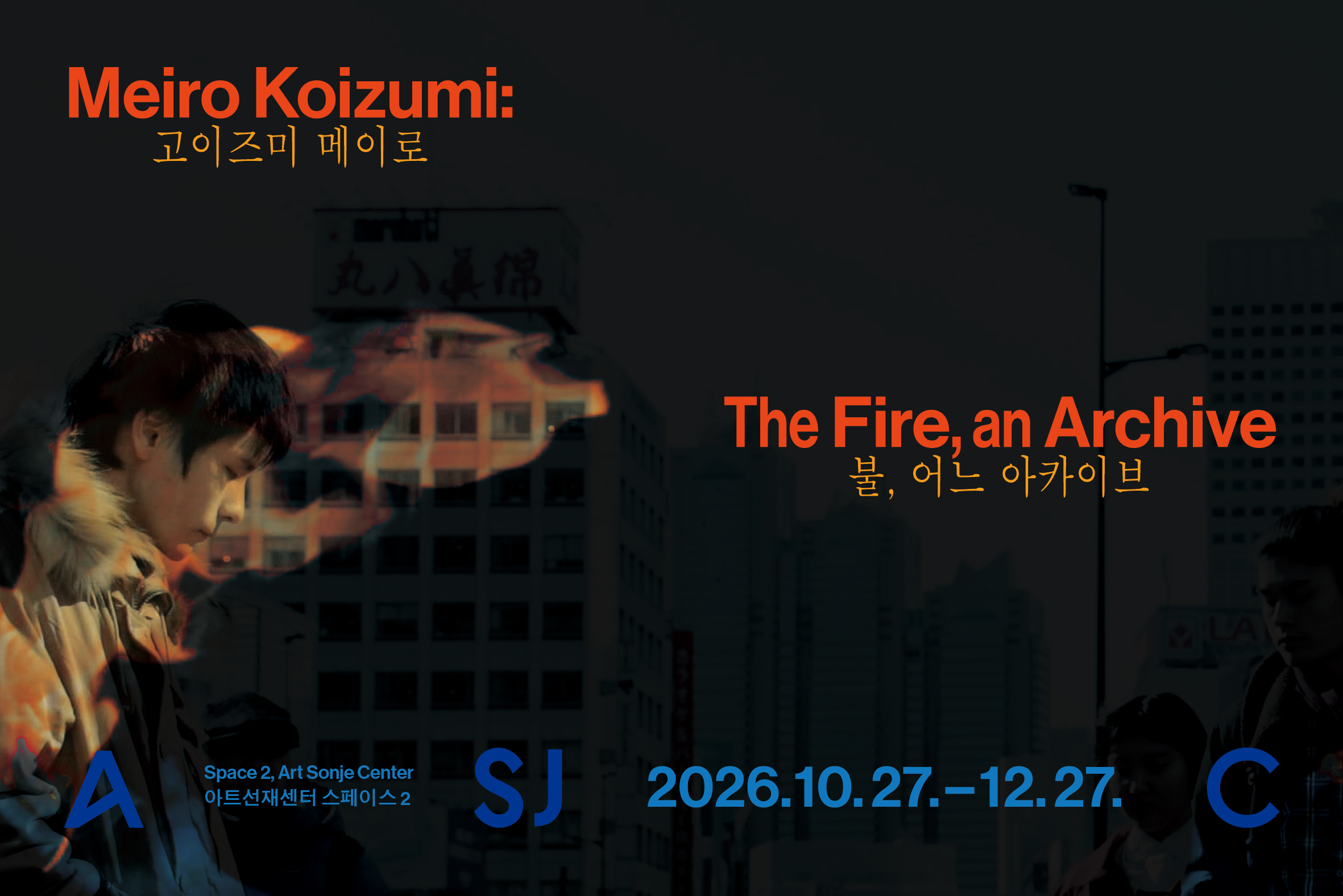
Meiro Koizumi: The Fire, an Archive
Meiro Koizumi: The Fire, an Archive examines social amnesia, the gradual erasure of history from collective memory. Historical records of war and nationalism document past events, but cannot fully convey the physical and emotional experiences of those who lived through them. Koizumi turns to what lies beyond these records, tracing memories held in voices, gestures, and involuntary bodily responses. Here, the body becomes an archive in its own right—not simply a means of representing the past, but a site where experiences left outside official records can emerge in the present.
The works in the exhibition explore the incomplete relationship between historical records and memory through images, objects, voices, and perception. The Fog series redraws everyday scenes from postwar films in charcoal before partially erasing them, revealing traces of history in images that evoke the war. In the three-channel video The Angels of Testimony, young participants recite a war veteran’s testimony, allowing a voice from the past to be spoken again in the present through the bodies of another generation. Secret Rite, a sculpture combining casts of human body parts with a car engine, explores the boundary between humans and machines. The VR work Prometheus the Fire-Bringer imagines how advances in biotechnology might change human vision and perception, examining the body as it is transformed through its relationship with technology.
Fire, central to the exhibition’s title, is one of humanity’s earliest technologies. In the myth of Prometheus, fire passes from the gods to humanity, expanding human capacities and changing the order of the world. Just as one flame can ignite another, experiences of the past can continue through the bodies and voices of those who did not live through them. In Koizumi’s work, the body becomes both an archive that resists forgetting by carrying traces of the past into the present and a site where the boundaries of sensory experience expand through encounters with technology. Histories left outside official records are transmitted through different bodies and reconstructed as new sensory experiences in the present. Through this process, the exhibition asks what becomes part of history, what is forgotten, and how experiences of the past are passed on to future generations.
About the Artist
Meiro Koizumi (b.1976)
Meiro Koizumi lives and works in Yokohama, Japan. He studied at International Christian University, Tokyo, and Chelsea College of Art and Design, London, and was a resident at the Rijksakademie van Beeldende Kunsten, Amsterdam, from 2005 to 2006. Working across video, performance, drawing, sculpture, virtual reality, and other media, Koizumi examines the ways individuals are shaped by political, cultural, and technological systems of power. His practice has consistently engaged with nationalism, Japan’s wartime history, and the relationship between individual experience and collective memory. In 2021, Koizumi was one of six artists jointly awarded the Artes Mundi 9 Prize, the UK’s largest contemporary art prize, for The Angels of Testimony. His work has been presented internationally through projects and exhibitions at institutions including the Museum of Modern Art, New York; Tate Modern, London; Kadist Art Foundation, Paris; Centro de Arte Caja de Burgos, Burgos; Artspace, Sydney; and Annet Gelink Gallery, Amsterdam. He has also participated in major international group exhibitions and biennials, including the Liverpool Biennial, Gwangju Biennale, and Shanghai Biennale, as well as exhibitions at Mori Art Museum, Tokyo; Museum of Contemporary Art Tokyo; National Museum of Modern and Contemporary Art, Korea; and Stedelijk Museum, Amsterdam.
Artist Talk
To mark the opening of the exhibition, an artist talk with Meiro Koizumi will take place on Tuesday October 27, 2026. Focusing on the works presented in this exhibition, the artist will share insights into his production process, background, and the central themes traversing his artistic practice.