


Haneyl Choi: Sleepwalking
Oct 27 – Dec 27, 2026
Space 1, Art Sonje Center
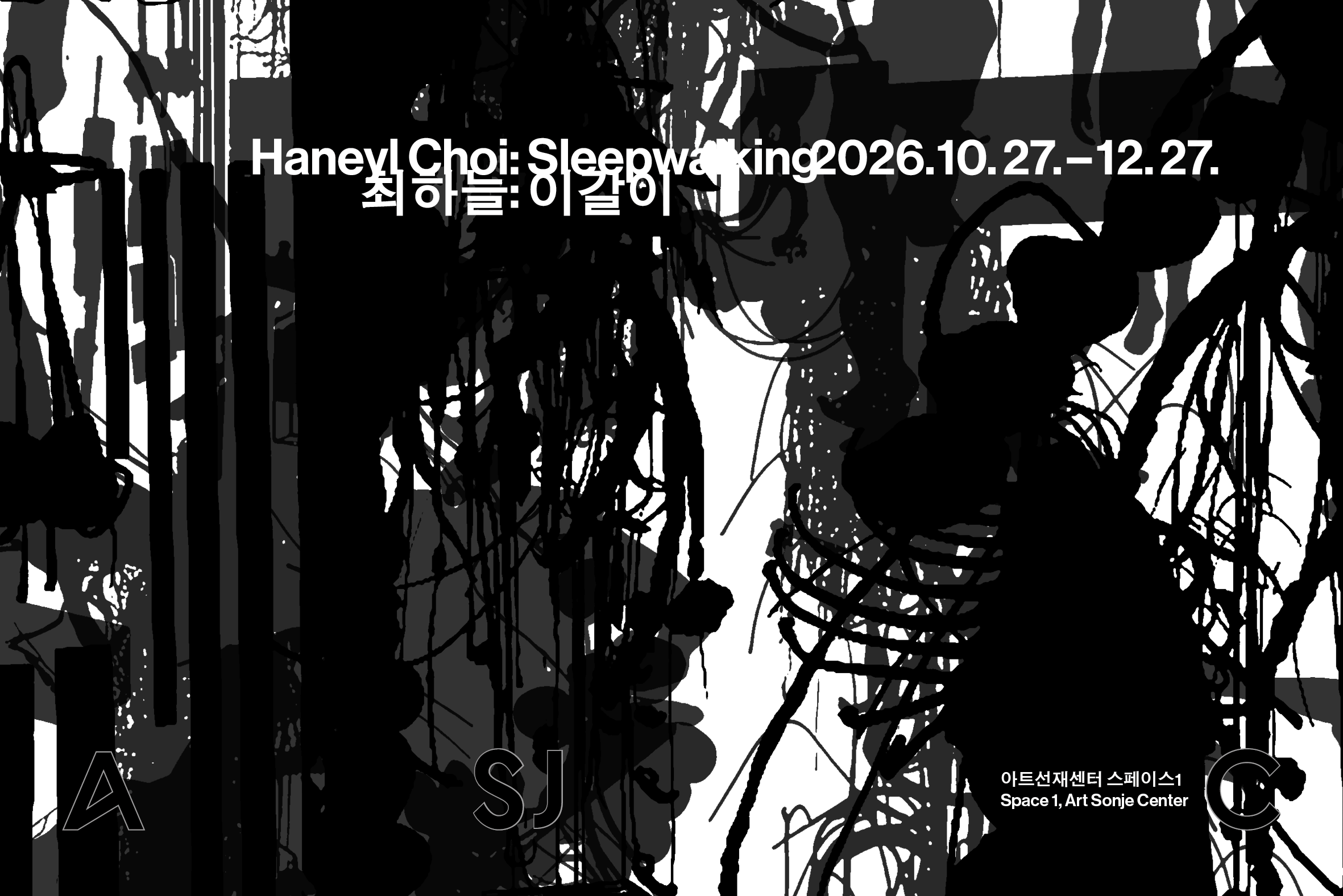
Haneyl Choi: Sleepwalking
Haneyl Choi: Sleepwalking starts from the point when the familiar body begins sliding away from the “self,” and consciousness and the body begin operating at different rhythms. We typically view consciousness as being in control of the body—but there are times when the body moves outside our will, responding ahead of our commands. We lose control over our body when intoxicated, we walk in our sleep, we experience sudden spasms in our muscles before falling asleep, and wounded tissue swells up on its own. The body is the basis of our experience of the self and the pathway through which we experience the world, but it is also something we are unable to fully fathom or control. Through the moments when consciousness and body fall out of sync, this exhibition poses questions about the way we understand the body and define our “self.”
Since having the experience of seeing inside his own damaged body, artist Haneyl Choi has imagined the parts within that are hidden beneath the skin. His attempts to see inside are driven by a desire to understand and possess the body, but they also paradoxically show how little we are able to know about it. The tissues, organs, and fluids that are revealed by wounds instantly transform a familiar body into an assemblage of strange substances and shapes. In Choi’s sculptures, the body manifests not as a completed structure or a fixed form but as a space in which different forces and movements meet and collide to create an uncannyorder. As they explore how control and deviation, intimacy and violence, and shame and temptation exist enmeshed in a single body, they trace the gap that exists between “me” and “my body.”
The twelve sculptures resemble sections of the body, situated in states of drooping, shaking, crashing, and falling as if barely clinging to life. A large stand that fans out at the end of a long corridor establishes a distance between the artwork and its viewer, limiting the image that reaches the eyes. As the viewer walks in a wide circle around the stand, the sculptures appear to approach and recede, overlap and scatter. In the bright white exhibition space, a chill silence seems to hover, as the bodies of the viewers appear clearly amid the sculptures—transforming “bodies that see” into “bodies that are seen.” As the viewer is placed in the same conditions as the artwork, they become conscious of their position, their movements, and even their breathing, coming face to face with the ways in which the body is perceived and recognized. The heightened sense of the body that comes with control and surveillance is amplified by the irregular mechanical noises and the colliding sounds of the sculptures, which reverberate through the quiet exhibition space.
The works in the exhibition come from four sculpture series: In a falling dream (2025–2026), In the act of dying (2024–2026), Abuse (2025–2026), and Keloid (2026). Each adopts a different approach to themes of falling, relaxation, the dissection and rearrangement of the body’s structures, and the regeneration that takes place after injury. In a falling dream uses fragmentary sculpture to represent the relaxation of the sleeping body and the body that falls to earth, as it poses questions about the body’s formal conditions. In the act of dying focuses on the connections between acts intended to relax the body and the shapes associated with death. This exhibition includes Choi’s first presentation of a kinetic version of In the act of dying that uses movements to represent misalignment between consciousness and the body. The moving sculptures evoke associations with a drunken body struggling and failing to stand up, two legs jerking just before falling asleep, and a sleepwalking figure. Through this, they show how unpredictable movements outside of our will exist even within the everyday bodies we regard as “normal.”
Abuse imagines the interior hidden beneath the body’s skin, reorganizing dissected fragments of the body into a kind of landscape. Forms and arrangement of the fragments that do not conform to actual anatomical structures expand the body into a terrain that is not reducible to a harmonious order or single shapes—one where anxieties and tensions coexist. Finally, the work from the Keloidseries maintains a poised lotus position amid the loosely defined contours of the other sculptures. Here, the focus is on the process of the damaged body creating new forms while leaving traces behind. The fragments sealed inside the transparent cube, along with the black lines formed by scorching the surface with a heating wire, reveal the order that attempts to control and regulate, as well as the vulnerability of the irreducible body within.
As it presents these multiple images of failing to control the body, the exhibition alternates between familiarity and strangeness, control and deviation. It shows that what we refer to as “my body” or a “normal body” is not in fact a fixed entity. In Haneyl Choi’s sculptures, the body undergoes repeated separation and combination, but it is not sutured into any one completed state. Different forces clash constantly, and what returns to us after the deconstruction, reconstruction, splitting, and proliferation is an unfamiliar form. Intertwined in those bodies are things that the consciousness does not grasp: movements and the workings of matter, gravity and inertia, desire and impulse, damage and recovery. Incompleteness of the body is not defined in terms of deprivation or failure; it becomes the condition for a different kind of balance and being. The sense of divergence that arises from the dissonance of consciousness and body creates cracks in the belief that the body is the property of the subject and follows the same order as the consciousness. In those fissures, we find unfamiliar bodies that deviate from what we know as the “self.”
About the Artist
Haneyl Choi (b. 1991)
Haneyl Choi works primarily in sculpture, exploring questions of desire, social norms, and self-perception that shape human existence. He approaches the human subject not as a coherent or self-contained whole, but as a site where conflicting desires, wills, and impulses become entangled, with particular attention to the points where individual interiority intersects with social order. In his work, the body functions as a primary sculptural device through which these psychological and social structures become visible. Choi has held solo exhibitions at P21 (2022, Seoul), Arario Museum (2021, Seoul), and Commonwealth and Council (2018, Los Angeles). He has participated in group exhibitions at Hauser & Wirth (2025, Hong Kong), the Gwangju Biennale (2024, Gwangju), Esther Schipper (2023, Berlin), Para Site (2022, Hong Kong), Karma International (2021, Zurich), the Ilmin Museum of Art (2020, Seoul), the Asia Culture Center (2020, Gwangju), the National Museum of Modern and Contemporary Art (2019, Gwacheon), and the Seoul Museum of Art (2018, Seoul), among other venues.